
Published on September 28, 2026, in the Brazilian Federal Official Gazette (and issued by the Brazilian National Monetary Council (Conselho Monetário Nacional – CMN) on September 24, 2026), Resolution No. 5,343 amends Resolution No. 2,907/2001 and prohibits Receivables Investment Funds (FIDCs) and Funds for Investment in Receivables Investment Fund Shares (FIC-FIDCs) from investing, directly or indirectly, in rights arising from lawsuits or arbitration proceedings until the relevant claim is definitively liquid, certain and enforceable. The proposal originated from the Judicial Fiscal Risk Monitoring Council (chaired by the Office of the Attorney General of the Union – AGU) and is intended to curb the proliferation of litigation against public entities. The affected market is significant: FIDCs had approximately BRL 35.2 billion in exposure to lawsuits as of July 2026, according to data from the Brazilian Securities and Exchange Commission (Comissão de Valores Mobiliários – CVM).
The finality threshold:
i. For litigation claims, the following requirements must be met cumulatively: (a) a final and unappealable judgment on the right asserted in the merits phase; (b) a final and unappealable decision in the liquidation proceedings, where applicable; and (c) expiration of the applicable period for filing an objection to enforcement or a challenge to enforcement proceedings, or a final and unappealable decision on any such objection or challenge.
ii. In arbitration, an arbitral award alone is not sufficient: the period for filing an action to set aside the award must have expired, or a final and unappealable decision on any such action must have been issued.
Key points: The prohibition also extends to structures that, although formally implemented through another instrument or vehicle, transfer to the FIDC the economic risks and benefits associated with litigation claims, including through securities, units of other investment funds, contractual instruments and derivatives linked to the outcome of the underlying claim. Accordingly, structures formally presented as “loans,” “advances” or other forms of financing must also be assessed in light of the prohibition whenever, in substance, they may result in the FIDC having economic exposure to a litigation claim.
Funds that already hold these claims in their portfolios are not required to dispose of them. However, beginning on January 4, 2027, they will become subject to more stringent requirements:
i. use a valuation methodology that is independently verifiable; valuation based solely on internal assumptions of the fiduciary administrator or investment manager is prohibited;
ii. reassess the claim whenever a relevant procedural event changes the expected value or likelihood of recovery;
iii. submit the valuation methodology adopted and any reassessments performed to independent auditor review; and
iv. disclose, on a monthly basis and in a structured electronic format, data on each claim, including the underlying proceeding, assignors and assignees, and related parties.
It is worth noting that the prohibition is not limited to claims against public entities and applies regardless of whether the debtor is a public or private entity. For claims enforceable against public entities, the required disclosures must also break down the exposure by debtor governmental entity, including the Federal Government, states, the Federal District, municipalities, and their respective agencies and foundations.
Effective dates: Prohibition on new investments: October 13, 2026. Audit and disclosure obligations: January 4, 2027.
Practical guide: may the claim be acquired by an FIDC?
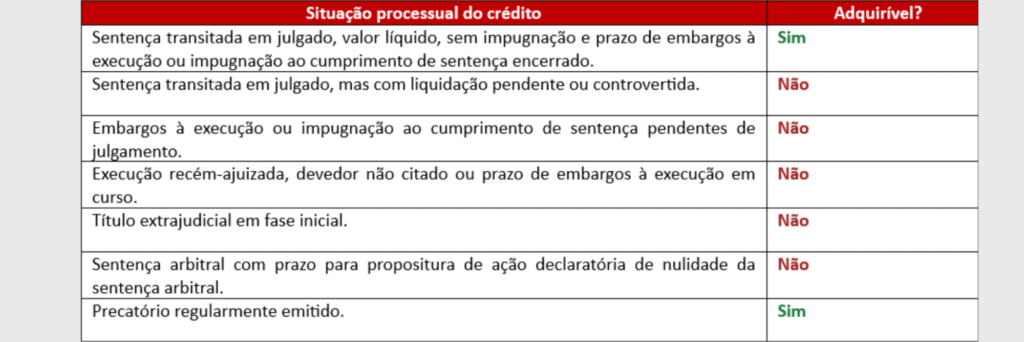
This table reflects our interpretation of the rule and does not replace a case-by-case analysis.
Our view: The purpose of the rule is legitimate: to increase transparency and address distortions observed in a market that has expanded significantly in recent years. The chosen approach, however, may produce effects broader than necessary to achieve those objectives. By requiring not only a final and unappealable determination of the underlying right but also the resolution of all disputes concerning amount and enforceability, the regulator significantly narrows the universe of claims that has traditionally comprised this segment. A substantial portion of the claims that are relevant to this marke, the so-called distressed claims, are precisely at this intermediate stage: proceedings in which the right has already been recognized but enforcement is still pending, the debtor has yet to be served, or the period for filing objections is still running.
Restricting acquisitions to claims that have already reached a high degree of finality materially reduces the scope for FIDCs to assume and price the risk inherent in litigation claims, one of the economic functions these structures had been performing. The regulatory concern with inadequate pricing and governance practices observed in certain transactions is relevant, although the effects of the new rule also extend to funds and service providers that had already adopted robust standards of diligence, valuation and monitoring for these assets.
An alternative regulatory approach could have strengthened or calibrated the governance mechanisms already in place, particularly independent valuation criteria, exposure limits and controls applicable to conflicts of interest, in a manner proportionate to the specific risks of these assets, rather than broadly restricting their acquisition by FIDCs.
This does not, however, mean the end of the market for financing or securitizing these assets. Other structures remain available, provided they are implemented through investment vehicles outside the scope of the prohibition and comply with the applicable regulatory framework and the characteristics of the relevant asset and transaction.
Recommendations: We recommend reviewing existing portfolios and ongoing transactions considering the new rules, mapping the procedural stage of each claim, suspending incompatible acquisitions before October 13, 2026, and preparing the valuation, audit and disclosure procedures required beginning in January 2027.
How we can help: Our Capital Markets and Civil Litigation teams are available to assist fiduciary administrators, investment managers and originators in adapting to the new rules.
On the Civil Litigation side, we are working on two immediate fronts: (i) procedural due diligence on finality, reviewing portfolios and target claims on an asset-by-asset basis to determine, based on the status of each proceeding (final judgment, liquidation and enforcement objections), whether and from what point the claim may be acquired by an FIDC; and (ii) monitoring the proceedings underlying assets already held in portfolio, identifying the decisions that, under Article 1-B, require the fund to reassess the claim beginning in January 2027.
On the Capital Markets side, we assess the impact of the new rule on existing funds and transactions and on structures currently being developed, including: (i) analysis of the regulatory treatment of portfolios and new acquisitions, including structures that may result in direct or indirect exposure to claims covered by the prohibition; (ii) review and amendment of fund regulations, investment policies, eligibility criteria and other fund documents; (iii) support to fiduciary administrators, investment managers and other service providers in implementing the valuation, reassessment, audit and disclosure procedures required under the new rule; and (iv) analysis of alternative structures for financing or securitizing these assets, taking into account the applicable regulatory framework and the characteristics of each transaction.
This content is provided for informational purposes only and does not constitute legal advice. The application of this information depends on the analysis of each specific case.